Replacing All Teeth · Washington, DC
Full-Arch Dental Implants in Washington, DC
For patients missing all upper or lower teeth — specialist-led full-arch planning rooted in bone, gum, and implant stability.
Direct answer
Full-arch dental implants replace all upper or lower teeth using a small number of implants — typically four to six — that support a fixed bridge or a stable removable prosthesis. Some patients leave the office the same day with a temporary set of teeth in place.
Why it matters: Patients with terminal dentition, failing dentures, or advanced gum disease often face a choice between continuing to lose teeth or replacing what is left with a planned, stable implant-supported restoration. Full-arch implants are designed for this decision.
Why see a periodontist: Full-arch reconstruction requires precise implant placement in the available bone, soft tissue management for esthetics and hygiene, and coordination with the restorative team that fabricates the final teeth. Specialist training matters at each step.
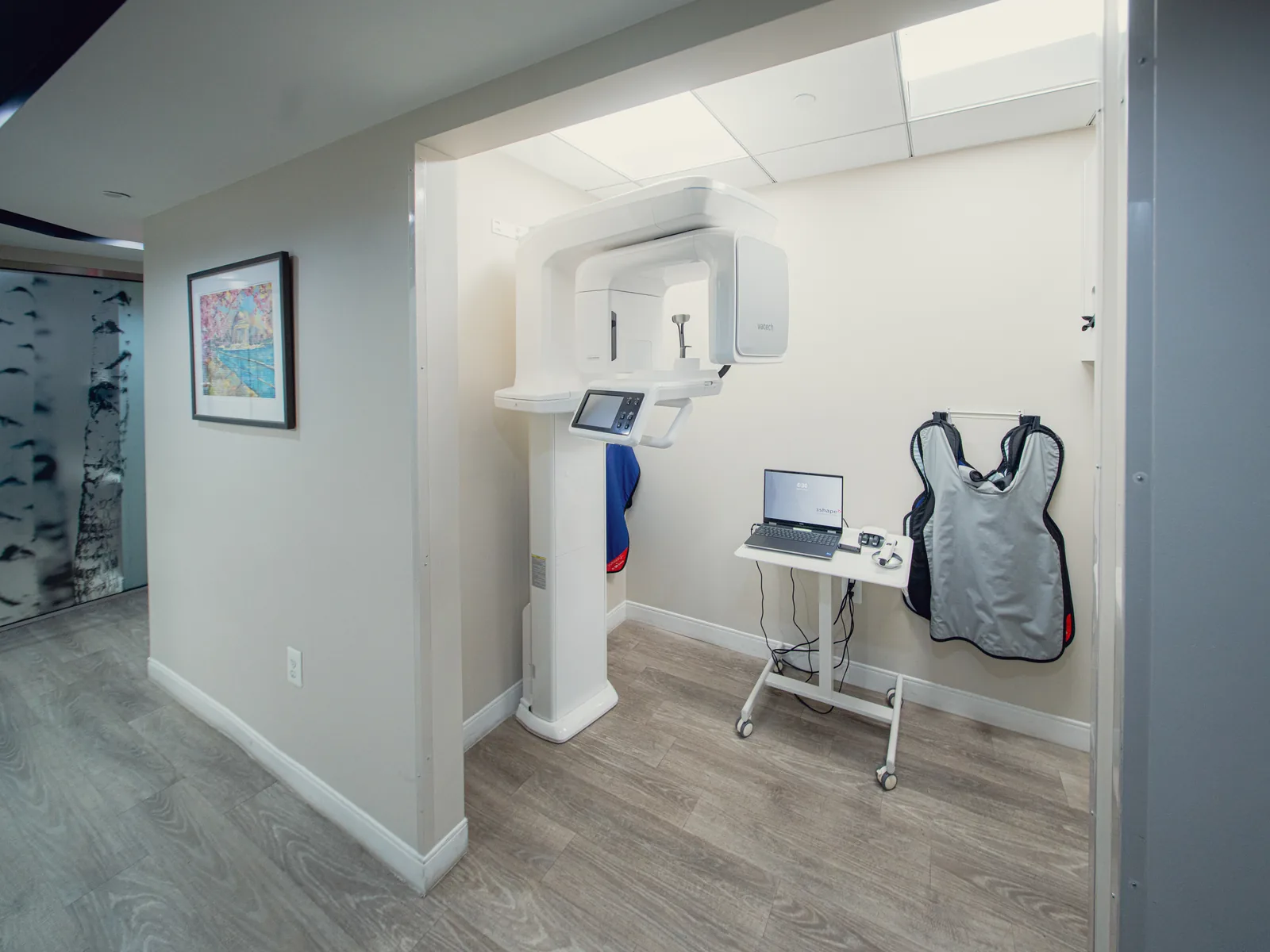
Next step in DC: DC Perio plans and places full-arch implant cases at both DC locations. Initial consultation includes a CBCT and a frank discussion of fixed vs. removable options, timeline, and what the experience actually looks like.


Who this is for
Patients who are missing all upper or lower teeth, or who are heading that direction with terminal dentition.
Patients who wear traditional dentures and are tired of the looseness, the adhesives, the gagging, or the bone loss that comes with long-term denture wear.
Patients who have been told their remaining teeth are not savable and want a planned transition rather than years of patchwork.
Fixed versus removable options
Fixed full-arch implants (sometimes called 'All-on-4' or 'All-on-X'): your teeth do not come out. They stay in your mouth. You brush and floss them like natural teeth, with specific tools for cleaning under the bridge.
Implant-supported overdentures: the denture clips onto the implants and is much more stable than a traditional denture, but you remove it for cleaning. Lower upfront cost than a fixed option in most cases.
Which path is right depends on bone, hygiene comfort, esthetic goals, and budget. We walk through both honestly at consultation.
Same-day teeth — when it's possible
In selected cases, patients can leave the office with a fixed set of temporary teeth the same day as implant placement. This depends on adequate bone, sufficient implant stability, healthy soft tissue, and a careful surgical plan.
Patient-specific exceptions apply. Same-day teeth is not appropriate for every case, and we will tell you plainly if your case is one where a staged approach (heal first, place final teeth later) gives you a better long-term outcome.
What planning looks like
CBCT 3D imaging to evaluate bone volume and density across the entire arch.
Discussion with your restorative dentist or our restorative partner about the final tooth design.
Bite analysis — how your teeth come together — because the bite is what tells us where the implants need to go.
Sedation planning. Most full-arch cases benefit from IV sedation; we discuss options at consultation.
What recovery looks like
Most full-arch patients return to office work within several days. Significant swelling and bruising for the first week is typical. Soft-food diet for several weeks while the bone integrates with the implants.
Follow-up visits at one week, one month, and three months. Final teeth are typically delivered after three to six months of healing — exact timing depends on the bone response and case complexity.
Common questions
Frequently asked about full-arch dental implants
- Is All-on-4 the same as full-arch implants?
- All-on-4 is one specific full-arch implant approach using four implants. Full-arch implants is the broader category, including approaches with four, five, six, or more implants depending on what your case requires. We use the implant count that gives the bone and bite the best support — not a marketing number.
- How many implants do I need for a full arch?
- Most upper-arch cases use four to six implants. Lower-arch cases sometimes use as few as four. The number depends on bone volume, bone quality, bite forces, and whether you grind your teeth. We plan from the case, not from a template.
- Can I leave with teeth the same day?
- In selected cases, yes — same-day temporary teeth are routine when bone, implant stability, and tissue conditions support it. Patient-specific exceptions apply, and we will tell you honestly at consultation whether your case is a same-day candidate or whether staging gives you a better long-term result.
- What is the difference between full-arch implants and dentures?
- Traditional dentures rest on the gum and often become loose as bone shrinks over time. Full-arch implants are anchored in the jaw and prevent the bone loss that comes with long-term denture wear. Fixed full-arch implants are not removed by the patient; implant-supported overdentures are removable but much more stable than traditional dentures.
- Am I a candidate if I have bone loss?
- Often, yes. Bone grafting, sinus lifts, and modern implant techniques can make implant treatment possible in many cases of bone loss that would have been told 'no' a decade ago. The CBCT at your consultation tells us what is and is not possible for your specific anatomy.
Your care team
Related care
Ready to talk through your options?
A consultation reviews your specific case and gives you honest options — not a pitch.